
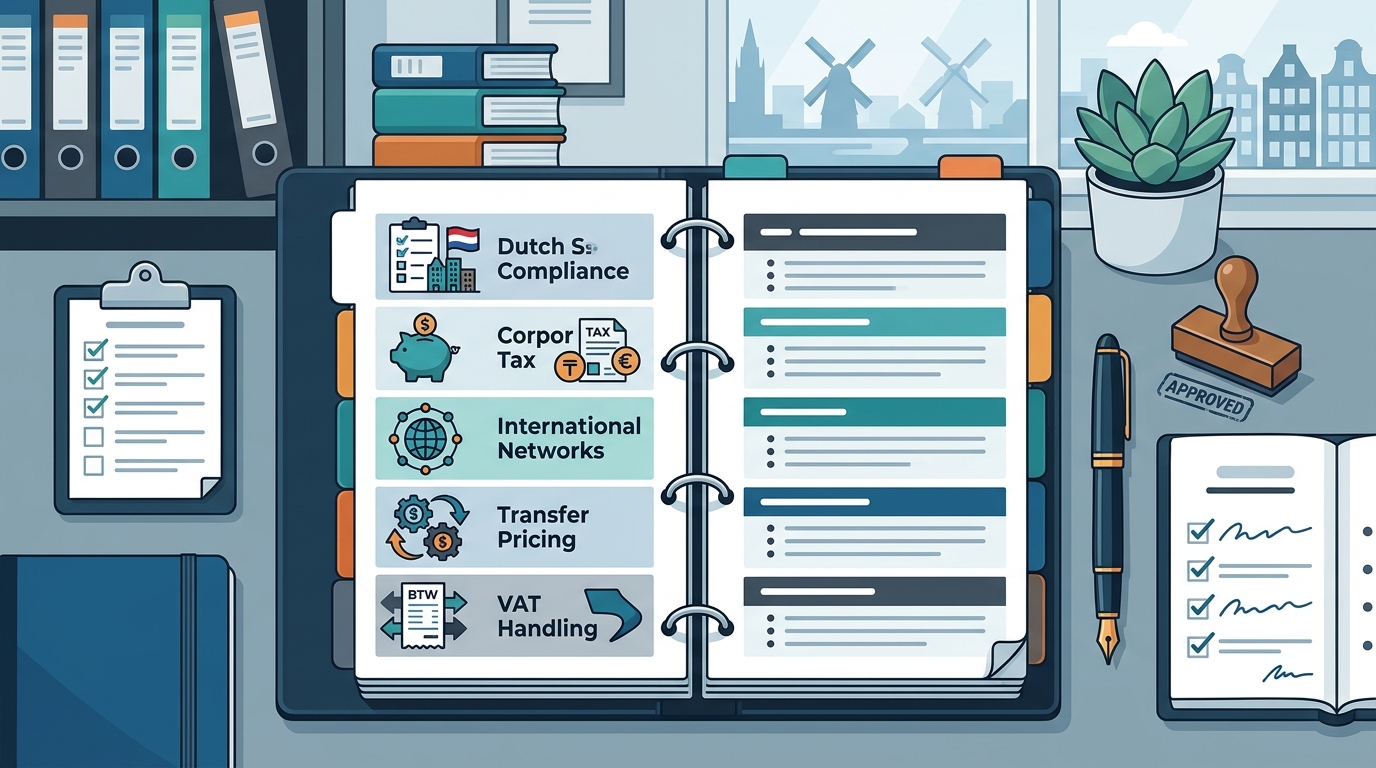
Choosing the right Dutch tax and accounting firm for an international subsidiary requires balancing local compliance expertise with cross-border advisory capabilities. Schmitz Tax Services provides independent tax advisory, accounting, and financial administration services specifically for business owners and expats navigating the Dutch system. This guide covers Dutch subsidiary compliance, corporate tax services, international networks, transfer pricing, and VAT handling to help you select the right partner.
Dutch Subsidiary Compliance
Dutch subsidiary compliance is the process of ensuring a foreign-owned entity meets all local legal and financial reporting obligations in the Netherlands. For international companies, this often feels like a separate administrative layer that must be managed alongside home-country reporting. The Dutch system is precise, and deadlines are strict. Missing a filing can result in penalties, even if no tax is due.
Core Administrative Obligations
Every Dutch private limited company (BV) must file annual accounts with the Chamber of Commerce. This is a public filing that must occur within twelve months of the end of the financial year. In addition to this, the company must file a corporate income tax return. The deadline for this return is five months after the end of the financial year. For many international groups, these two deadlines do not align with their home-country reporting cycles, creating a need for dedicated local support.
The Role of Bookkeeping
Accurate bookkeeping is the foundation of compliance. It is not merely a back-office task; it is the source of truth for all tax filings. Bookkeeping for a Dutch BV ensures that records stay current throughout the year. This approach prevents the common issue where errors only surface at year-end, requiring costly corrections. Up-to-date records also allow for interim reporting, which is often required by banks or investors.
Payroll and Employment
If your Dutch subsidiary employs staff, payroll tax becomes a critical compliance area. Payroll taxes must be withheld and remitted to the Dutch Tax Administration. This requires a separate registration and quarterly filings. Managing this in-house is difficult for foreign groups. A local partner can handle the payroll administration, ensuring that staff are paid correctly and that the tax authorities receive the required reports on time.
Corporate Tax Services
Corporate tax services in the Netherlands involve the preparation and filing of the corporate income tax return, as well as strategic advice on the tax position of the entity. The Dutch corporate income tax system has two brackets. The first bracket applies to the first EUR 20,000 of taxable profit, and the second bracket applies to the remainder. The tax rates are subject to change, so staying current with the legislation is essential.
Preparation and Filing
The corporate income tax return is a complex document. It requires detailed financial statements and specific tax adjustments. A professional firm prepares a draft return for your review. This draft allows you to verify the figures before they are filed. Once filed, the Tax Administration issues an assessment. A good tax adviser will compare this assessment against the filed return to ensure accuracy. If there are discrepancies, the adviser can raise an objection on your behalf.
Strategic Tax Planning
One-Off and Second Opinion Services
Not every question requires an ongoing engagement. Sometimes, you need a second opinion on a specific issue, such as a letter from the Tax Administration or a structure that was set up years ago. One-off tax advice provides a fresh look at these situations without the commitment of a permanent retainer. This is useful for international groups that may already have a local accountant but need specialized advice on a particular cross-border issue.
International Firm Networks
International firm networks are associations of independent accounting and tax firms that collaborate to serve multinational clients. These networks allow a local firm to provide consistent service across multiple countries. For an international company, this means you can have a single point of contact in the Netherlands who can coordinate with firms in other jurisdictions.
Why Networks Matter
When you operate in multiple countries, you need consistency in reporting and advice. A network ensures that the firm in the Netherlands understands the standards and expectations of your home country. It also facilitates the exchange of information and best practices. However, it is important to understand that network members are independent firms. They are not a single global entity. The local firm remains responsible for its own work and advice.
Choosing a Network Partner
When evaluating a firm, ask about their network affiliations. Do they belong to a recognized international association? What is the size of the network? How do they handle cross-border coordination? Schmitz Tax Services brings experience from working with multinationals and in-house tax departments. This background informs the approach to cross-border questions, even if the firm operates as an independent practice. The key is to find a partner who understands the operational side of your business, not just the tax forms.
Transfer Pricing
Transfer pricing is the determination of the price for goods, services, or intangibles exchanged between related parties. The Dutch Tax Administration requires that these transactions be conducted at arm's length. This means the price should be the same as if the parties were unrelated. Failure to comply can result in adjustments and penalties.
Documentation Requirements
Strategic Considerations
Transfer pricing is not just a compliance exercise; it is a strategic tool. It affects the profitability of each entity in the group and, consequently, the tax burden. A well-designed transfer pricing policy can optimize the group's overall tax position while remaining compliant with local rules. This requires advice from a firm that understands both the Dutch rules and the international standards. Tax advice can help you assess the sustainability of your existing transfer pricing arrangements and identify areas for improvement.
VAT Handling
VAT handling in the Netherlands involves the registration, filing, and payment of Value Added Tax. For international companies, VAT can be particularly complex due to the rules on cross-border supplies. The Dutch VAT system is based on the EU VAT Directive, which means that the rules are largely harmonized across the EU, but local implementation can vary. according to The INAA Traveller
Registration and Filing
If your Dutch subsidiary makes taxable supplies in the Netherlands, it must register for VAT. VAT returns are filed quarterly. The return includes details of sales, purchases, and the VAT charged and paid. For companies trading within the EU, an EC Sales List must also be filed. This list provides details of intra-community supplies. Filing these returns accurately is essential to avoid penalties and to ensure that you can reclaim any VAT paid on purchases.
Cross-Border Complexity
Cross-border transactions can trigger VAT in multiple jurisdictions. For example, a service provided from the Netherlands to a client in Germany may be subject to VAT in Germany, not the Netherlands. Determining where the VAT is due requires a careful analysis of the nature of the supply and the location of the customer. This is where local expertise is critical. A firm that understands the Dutch rules and the EU framework can help you navigate these complexities. Tax return services include the preparation and filing of VAT returns, ensuring that they are accurate and on time.
Key Takeaways
- Compliance is foundational: Dutch subsidiary compliance requires strict adherence to deadlines for annual accounts and tax returns.
- Bookkeeping drives accuracy: Up-to-date bookkeeping prevents year-end errors and supports interim reporting needs.
- Corporate tax has two brackets: The Dutch corporate income tax system applies different rates to different levels of profit.
- Networks offer consistency: International firm networks can provide coordinated service across multiple countries, but local independence remains.
- Transfer pricing requires documentation: Related-party transactions must be priced at arm's length and documented in a master and local file.
- VAT is complex cross-border: Determining where VAT is due on cross-border supplies requires analysis of the nature of the supply and customer location.
- Choose a partner who understands your business: The best tax adviser starts from the operational side of the business to assess the tax position.
Frequently Asked Questions
What is the deadline for filing annual accounts in the Netherlands?
Annual accounts for a Dutch BV must be filed with the Chamber of Commerce within twelve months of the end of the financial year. This is a public filing and is separate from the tax return.
What is the deadline for the corporate income tax return?
The corporate income tax return is due five months after the end of the financial year. For a calendar year, this means the return is due by May 1 of the following year.
Do I need to register for VAT if I only make cross-border supplies?
It depends on the nature of the supplies and the location of the customers. If you make taxable supplies in the Netherlands, you must register for VAT. If you only make exempt supplies or supplies outside the Netherlands, you may not need to register. This requires a specific analysis.
What is transfer pricing documentation?
Can I use my home-country accountant for Dutch tax matters?
While your home-country accountant may understand your global structure, they may not be familiar with the specific Dutch rules and procedures. It is often beneficial to work with a local firm that can handle the Dutch filings and coordinate with your home-country accountant.
What is the role of a holding structure in the Netherlands?
A holding structure can be used to hold shares in operating companies. It can offer tax advantages, such as the participation exemption, which exempts dividends and capital gains on qualifying shares from corporate income tax. Whether a holding structure is beneficial depends on your specific circumstances.
How do I choose the right tax firm for my Dutch subsidiary?
Look for a firm that understands your industry and your cross-border structure. Ask about their experience with international clients and their approach to compliance and advice. A good firm will start by understanding your business before assessing the tax position.
Conclusion
Selecting the right Dutch tax and accounting firm for your international subsidiary is a critical decision. You need a partner who understands the local compliance requirements, the complexities of cross-border transactions, and the operational side of your business. Schmitz Tax Services offers a single point of contact for tax returns, bookkeeping, and tax advice, with a focus on clarity and reliability. To discuss your specific situation, for an introductory conversation.