
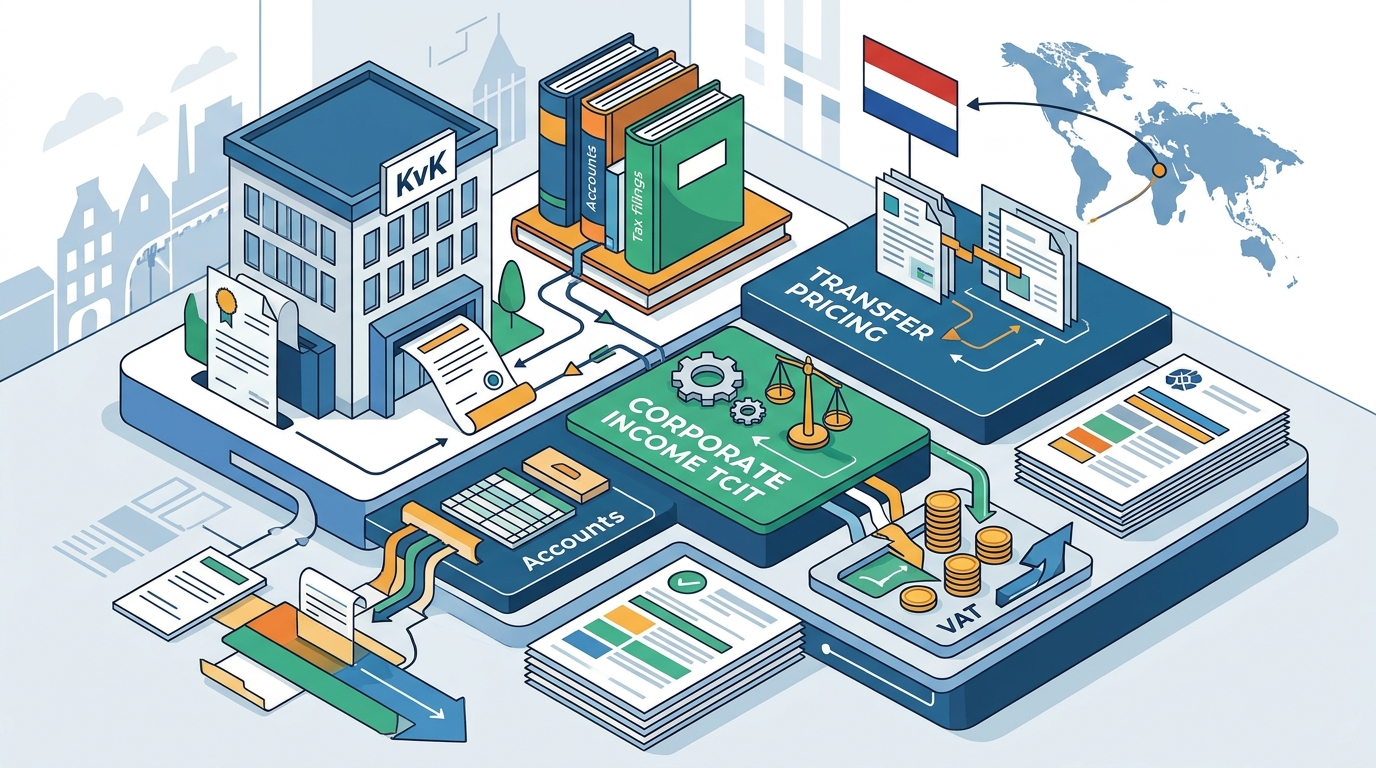
Establishing a Dutch subsidiary involves specific tax and accounting obligations that differ significantly from those in many other jurisdictions. Foreign companies must navigate corporate income tax, dividend withholding tax, and strict registration requirements to operate legally. This guide outlines the core compliance steps, including transfer pricing documentation and Chamber of Commerce registration, to help you prepare for a smooth market entry. according to Netherlands United States
Transfer Pricing Documentation
Transfer pricing is the pricing of goods, services, or intangible property between related parties. For a foreign parent company establishing a Dutch subsidiary, these internal transactions must be priced at arm's length. This means the price charged must be the same as what would be charged between independent parties in a similar situation. The Dutch Tax Administration requires this to prevent profit shifting out of the Netherlands.
Documentation Requirements
Arm's Length Principle
The arm's length principle is the standard for determining the price of transactions between related parties. It ensures that each entity in the group is taxed based on its own economic activities and functions. For a Dutch subsidiary, this means documenting why the subsidiary performs certain functions and what risks it bears. The documentation must support the allocation of profits to the Dutch entity. This is critical because the Dutch corporate tax rate is competitive, but the tax authorities are strict about ensuring the correct profit is taxed in the Netherlands.
Dividend Withholding Tax
Dividend withholding tax is a tax levied on dividends paid by a Dutch company to non-resident shareholders. When a foreign parent company receives dividends from its Dutch subsidiary, this tax may apply. The standard rate is 15%, but it can be reduced to 5% if the parent company holds a substantial interest in the subsidiary. A substantial interest is generally defined as a holding of at least 10% of the capital, held for at least 300 days.
Exemptions and Reductions
Many foreign companies can avoid or reduce this tax through double taxation treaties. The Netherlands has an extensive network of treaties with other countries. These treaties often provide for a reduced withholding tax rate or a full exemption. To benefit from these reductions, the subsidiary must file the appropriate forms with the Dutch Tax Administration. The parent company must also provide a certificate of tax residence. This process requires careful coordination between the Dutch subsidiary and the foreign parent.
Impact on Cash Flow
Withholding tax affects the cash flow available to the parent company. It is deducted at the source, meaning the subsidiary pays the tax to the Dutch authorities before sending the net dividend to the parent. This reduces the effective return on investment. Companies should model this tax impact when planning their capital structure and dividend policies. Understanding the treaty benefits is essential for accurate financial forecasting.
KvK Registration Requirements
The Chamber of Commerce, or KvK, is the official registry for all businesses in the Netherlands. Registration is mandatory for any company operating in the country. A foreign company establishing a Dutch subsidiary must register the new legal entity with the KvK. This registration provides the company with a unique KvK number, which is required for opening bank accounts, signing contracts, and filing tax returns.
Registration Process
The registration process involves submitting the company's articles of association and other legal documents to the KvK. A notary must draw up the articles of association for a private limited company (BV). The registration confirms the legal existence of the company. It also makes the company's basic information public. This includes the name, address, and nature of the business. The process is straightforward but requires accurate documentation.
Ongoing Obligations
Once registered, the company must keep its KvK details up to date. Any changes to the company's address, directors, or business activities must be reported to the KvK. The company is also required to file its annual accounts with the KvK. For a BV, this must be done within 12 months of the end of the financial year. The accounts are then published in the Dutch Trade Register. This transparency is a key feature of the Dutch business environment.
| Obligation | Key Requirement | Frequency |
|---|---|---|
| Transfer Pricing | Arm's length documentation | Annual |
| Dividend Withholding Tax | 15% standard, 5% substantial interest | Per distribution |
| KvK Registration | Legal entity registration | One-time, then updates |
| Annual Accounts | Filing with KvK | Annual |
Key Takeaways
- Transfer pricing documentation is mandatory for related-party transactions and must follow the arm's length principle.
- Dividend withholding tax is 15% by default but can be reduced to 5% for substantial interest holdings.
- Double taxation treaties can further reduce or eliminate withholding tax on dividends.
- Registration with the Dutch Chamber of Commerce (KvK) is a legal requirement for all operating entities.
- Annual accounts must be filed with the KvK within 12 months of the financial year-end.
- Proper bookkeeping is the foundation for accurate tax returns and compliance.
- Engaging a local tax adviser helps navigate the specific nuances of Dutch tax law.
Frequently Asked Questions
What is the standard dividend withholding tax rate in the Netherlands?
The standard rate is 15%. However, it is reduced to 5% if the shareholder holds a substantial interest, typically defined as at least 10% of the capital.
Do I need to register with the KvK if I am a foreign company?
Yes, if you establish a Dutch subsidiary or branch, you must register with the Dutch Chamber of Commerce. This is a legal requirement for operating in the Netherlands.
What is the arm's length principle in transfer pricing?
The arm's length principle is the standard for pricing transactions between related parties. It requires that the price be the same as what would be charged between independent parties.
How often must I file my annual accounts with the KvK?
Annual accounts must be filed with the KvK within 12 months of the end of the financial year. This applies to all private limited companies (BV) in the Netherlands.
Can I use a double taxation treaty to reduce withholding tax?
Yes, the Netherlands has treaties with many countries that can reduce or eliminate withholding tax. You must file the appropriate forms and provide a certificate of tax residence to benefit from these reductions.
What documents are needed for KvK registration?
You need the articles of association, drawn up by a notary, and other legal documents establishing the company. The registration confirms the legal existence of the entity.
Conclusion
Establishing a subsidiary in the Netherlands offers access to a stable and competitive business environment. However, it requires careful attention to tax and accounting obligations. From transfer pricing documentation to dividend withholding tax and KvK registration, each step is critical for compliance. Schmitz Tax Services provides specialized support for foreign companies and expats navigating these requirements. Our team offers clear, in English, guidance on tax returns, bookkeeping, and annual accounts. To discuss your specific situation, for an introductory conversation. according to Netherlands United States