
International companies operating in the Netherlands must adhere to strict local tax, corporate, and reporting standards. Compliance involves timely filing of corporate income tax, VAT, and payroll obligations, alongside maintaining accurate books and records. Schmitz Tax Services helps foreign entities navigate these Dutch compliance rules by providing specialized tax returns, bookkeeping, and advisory support in English.
Corporate Structure and Registration Requirements
Before conducting business, an international company must establish a valid legal presence in the Netherlands. The most common structure for foreign entities is the Dutch private limited company, known as a BV. A BV is a legal entity with limited liability, separate from its owners, and is the standard vehicle for operating in the Dutch market. Registration with the Dutch Chamber of Commerce (Kamer van Koophandel) is mandatory for all active businesses. This registration provides a unique Chamber of Commerce number, which is required for opening bank accounts, signing contracts, and filing taxes.
For companies that do not establish a physical office but still generate income in the Netherlands, the concept of a permanent establishment (PE) is critical. A permanent establishment is a fixed place of business through which an enterprise carries on all or part of its business. If a PE is created, the company becomes liable for Dutch corporate income tax on the profits attributable to that establishment. Schmitz Tax Services advises on the structural implications of these registrations to ensure the legal form aligns with the operational reality of the business.
Core Tax Obligations and Filing Deadlines
Deadlines are strict, and late filing results in penalties even if no tax is due. The income tax return for a calendar year can be filed from 1 March of the following year and is generally due before 1 May. For corporate income tax, the deadline is five months after the end of the financial year. Schmitz Tax Services monitors these deadlines as part of its service, ensuring that returns are filed on time and in line with Dutch tax law. The firm provides a draft beforehand and checks the assessment afterwards to verify accuracy.
Bookkeeping and Financial Reporting Standards
Accurate record-keeping is the foundation of Dutch compliance. Companies are required to maintain complete and accurate books and records that reflect their financial position. Bookkeeping is the systematic recording of financial transactions, including income, expenses, assets, and liabilities. For BVs, the preparation of annual accounts is mandatory, and these accounts must be filed with the Chamber of Commerce. The annual accounts provide a snapshot of the company's financial health and form the basis for the corporate income tax return. Keeping records current throughout the year ensures that figures are usable when needed, rather than only after the fact. according to Webinar Product Safety
International companies often struggle with the specific requirements of Dutch bookkeeping, particularly when dealing with cross-border transactions. Schmitz Tax Services offers full bookkeeping for BVs and sole proprietorships, ensuring that records stay up to date. This includes handling VAT returns, annual accounts, and the figures that form the basis for tax returns. By maintaining current records, companies can respond quickly to inquiries from the Tax Authorities or banks, reducing the risk of compliance issues. according to Information Return Filing
Cross-Border Considerations and Transfer Pricing
Additionally, companies with income from more than one country or assets held elsewhere face complex reporting requirements. The M-form, for example, is filed in the year of arrival or departure and reports worldwide income and assets. Questions that rarely stop at one tax system require a holistic view of the Dutch rules and the rules of other countries. Schmitz Tax Services provides advice on situations involving more than one country, ensuring that the Dutch position is assessed in the context of the broader international structure.
Consequences of Non-Compliance
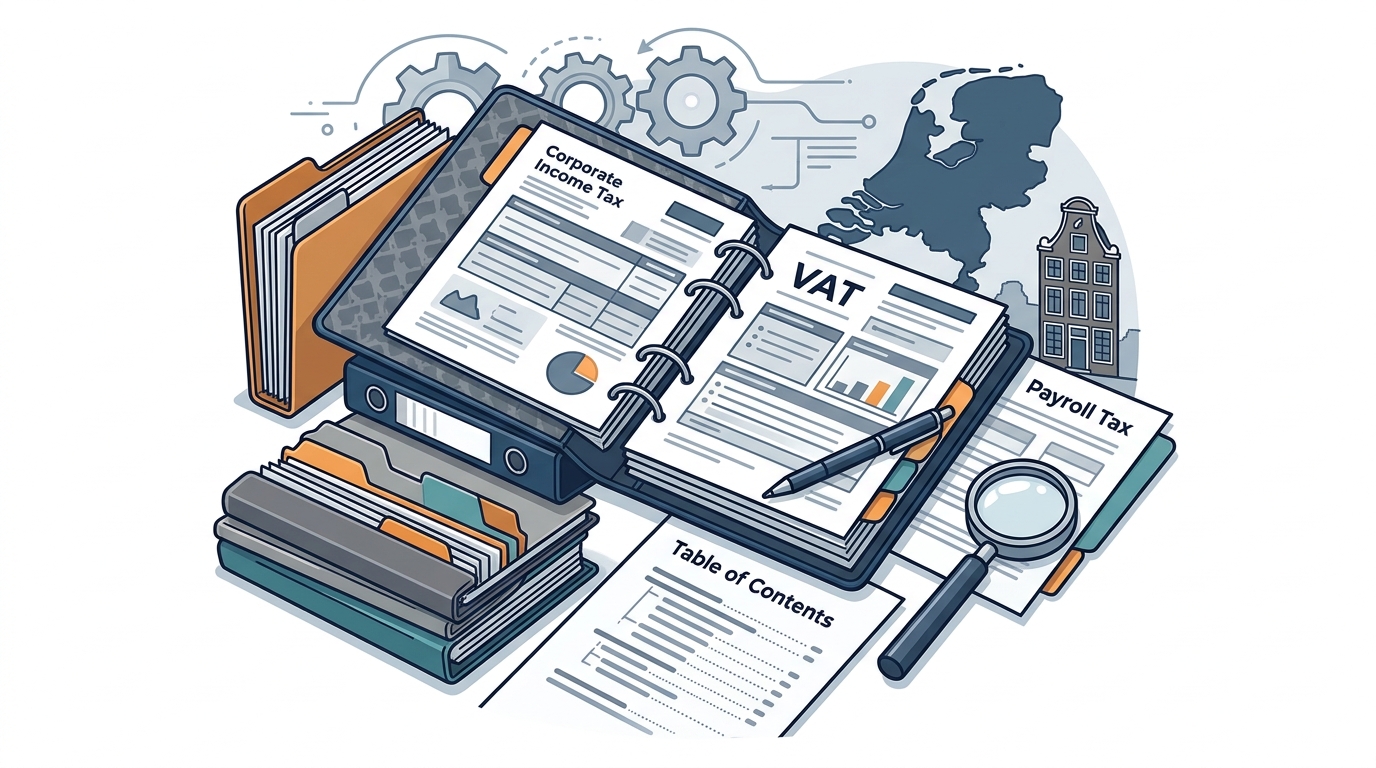
Failure to comply with Dutch tax and corporate rules can lead to significant financial and reputational damage. Penalties for late filing or incorrect returns can be substantial, and in cases of deliberate non-compliance, criminal sanctions may apply. The Dutch Tax Administration has the authority to conduct audits and request detailed documentation. A preliminary assessment that no longer matches reality can trigger an objection process, which requires a formal response. Understanding the risks of non-compliance is essential for international companies operating in the Netherlands.
Proactive compliance management helps mitigate these risks. By working with a specialized tax adviser, companies can identify potential issues before they become problems. Schmitz Tax Services focuses on the decisions that outlast recurring obligations, helping clients navigate the tax consequences of their business models. The firm's approach ensures that the tax position is assessed based on the actual activities and money flows, rather than just the legal structure. according to Webinar Product Safety
Key Takeaways
- Registration with the Dutch Chamber of Commerce is mandatory for all active businesses, including foreign entities with a permanent establishment.
- Corporate income tax returns must be filed within five months after the end of the financial year, with standard rates of 20% and 25%.
- Quarterly VAT returns are required, with a standard rate of 21% on the supply of goods and services.
- Accurate bookkeeping and annual accounts are mandatory for BVs and form the basis for tax returns.
- Transfer pricing rules require arm's length pricing for transactions between related parties, with strict documentation requirements.
- Non-compliance can result in penalties, audits, and criminal sanctions, making proactive management essential.
- International companies should seek advice on cross-border issues to ensure their Dutch position aligns with their global structure.
Frequently Asked Questions
Do I need to register a BV to operate in the Netherlands?
You do not always need a BV, but you must register with the Chamber of Commerce if you have a permanent establishment. A BV is the most common structure for foreign companies, but other forms like a branch or sole proprietorship are also possible depending on your activities.
What is the deadline for filing corporate income tax in the Netherlands?
The corporate income tax return must be filed within five months after the end of the financial year. For a calendar year financial year, this means the deadline is typically 1 May of the following year.
What are the consequences of late filing?
Late filing results in a penalty, even when there is nothing to pay. The penalty amount depends on the length of the delay and the amount of tax involved. Repeated late filing can lead to higher penalties and increased scrutiny from the Tax Authorities.
Do I need to file VAT returns if I have no Dutch customers?
If you are registered for VAT in the Netherlands, you must file quarterly VAT returns, even if you have no Dutch customers. You may be able to claim a refund of VAT paid on purchases, but the filing obligation remains.
How does Schmitz Tax Services help with compliance?
Schmitz Tax Services provides tax returns, bookkeeping, and tax advice for business owners and expats. The firm monitors deadlines, prepares drafts, and checks assessments to ensure compliance. It also offers advice on cross-border issues and structural choices.
What is a permanent establishment?
A permanent establishment is a fixed place of business through which an enterprise carries on all or part of its business. If a foreign company has a PE in the Netherlands, it is liable for Dutch corporate income tax on the profits attributable to that PE.
Navigating Dutch Compliance with Expert Support
Operating in the Netherlands requires a clear understanding of local compliance rules. From registration and tax filing to bookkeeping and cross-border considerations, the obligations are specific and strictly enforced. Schmitz Tax Services provides the in-house tax department you don't have yourself, offering tax returns, bookkeeping, and tax advice for business owners and expats. To plan your visit or discuss your compliance needs, for a free introductory conversation.