
Registering a Dutch BV (besloten vennootschap) is a significant legal and financial step that fundamentally alters your tax position. Before you sign the notarial deed, you must understand how the legal form dictates your income tax, corporate tax, and VAT obligations. At Schmitz Tax Services, we advise that the choice between a sole proprietorship and a BV is not just about liability, but about long-term cash flow and administrative complexity. This guide outlines the critical tax factors you must weigh before incorporating.
The Legal Form Determines Your Tax Liability
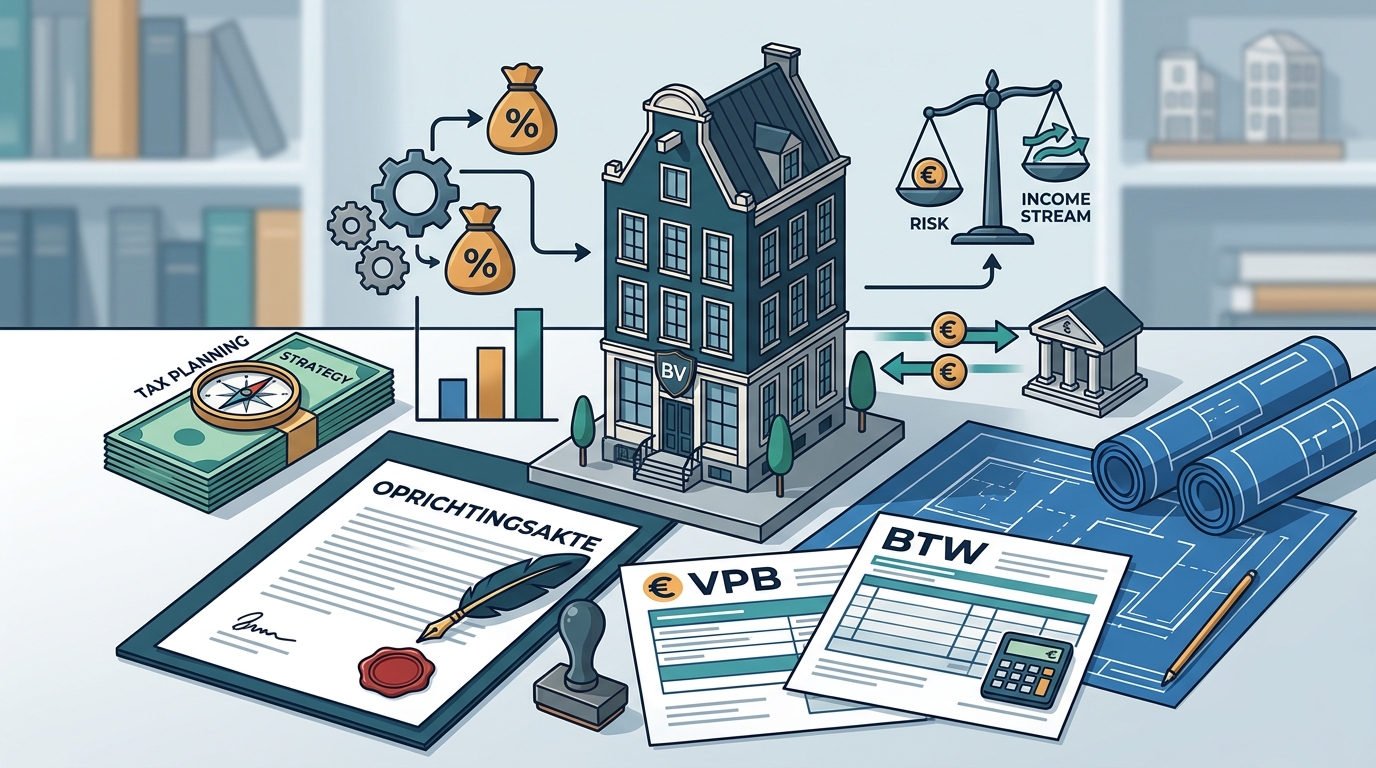
The legal form of your business is the primary driver of your tax obligations. A BV is a separate legal entity, meaning the company itself pays corporate income tax (vennootschapsbelasting) on its profits. As the owner, you are taxed separately on the income you receive from the company, such as dividends or salary. This separation creates a distinct tax profile compared to a sole proprietorship (eenmanszaak), where business profits are taxed directly as personal income.
Understanding this split is essential for cash flow planning. Corporate income tax in the Netherlands is progressive, with a lower rate applied to the first portion of profit and a higher rate on the remainder. However, the timing of when you extract money from the company matters. If you leave profits in the BV, they are taxed at the corporate rate. If you take them out as dividends, they are taxed at the dividend tax rate. If you take them out as salary, they are taxed at income tax rates. Each route has different implications for your net take-home pay and the company's liquidity.
At Schmitz Tax Services, we analyze your specific business model to determine which structure aligns with your goals. We look at the actual activities and money flows to assess the tax position, ensuring the structure is sustainable and not just a theoretical exercise.
Salary vs. Dividend: The Director's Dilemma
One of the most common questions for new BV owners is how to pay themselves. Dutch tax law requires a director who works in their own BV to receive a mandatory director's salary (verplichte directeurssalaris). This salary must be at least a certain percentage of the minimum wage, adjusted for the hours worked. Failing to pay this salary can result in the Tax Administration treating dividends as salary, leading to higher tax and social security contributions.
Beyond the mandatory salary, you must decide how much to pay yourself in salary versus dividends. Salary is subject to income tax and social security contributions (loonheffing), which the BV must withhold and pay to the Tax Administration. Dividends are subject to dividend tax (dividendbelasting) and are generally not subject to social security contributions. The optimal split depends on your personal tax bracket, the company's profit level, and your long-term wealth building strategy.
For example, if you are in a high personal income tax bracket, taking more dividends might be more efficient than taking a high salary. However, if you need to build up pension rights or social security benefits, a higher salary might be preferable. This is not a one-size-fits-all decision. It requires a detailed calculation of your personal and corporate tax positions. We provide written advice setting out these options and recommendations in clear language, so you can make an informed decision.
Bookkeeping and Annual Accounts: The Administrative Burden
A BV has stricter administrative obligations than a sole proprietorship. You must keep full bookkeeping records and prepare annual accounts. These accounts must be filed with the Chamber of Commerce (Kamer van Koophandel) within twelve months of the end of the financial year. This is a legal requirement, and failure to comply can result in fines and penalties.
Bookkeeping is the basis for your tax returns. If your records are not up-to-date, you cannot accurately calculate your VAT, corporate income tax, or payroll tax. At Schmitz Tax Services, we offer full bookkeeping services that keep your records current throughout the year. This means the figures are usable when you need them, not just at year-end. We process your financial data into VAT returns and provide interim reporting, so you always know where your business stands.
The administrative effort of a BV is higher, but it is manageable with the right support. We handle the bookkeeping and financial administration, allowing you to focus on running your business while your administrative obligations are met.
Holding Structures: When Do They Make Sense?
Many business owners consider setting up a holding structure, where a holding company owns the shares of the operating BV. A holding structure can offer tax advantages, such as the participation exemption (deelnemingsvrijstelling), which exempts dividends received by the holding company from corporate income tax. It can also provide asset protection and facilitate the transfer of shares.
However, a holding structure is not always beneficial. It adds complexity and cost, including additional bookkeeping and annual accounts for the holding company. It also has implications for your personal tax position, particularly regarding Box 2 (substantial interest) and Box 3 (savings and investments). Whether a holding structure makes sense depends on your specific circumstances, such as the size of your business, your long-term plans, and your personal wealth.
We advise on whether a holding structure adds value to your situation. We assess the tax consequences of setting up a holding, including the impact on your personal tax return and the administrative burden. Our advice is based on your business model and actual activities, not on generic templates. We help you decide if the complexity is worth the potential benefits.
Cross-Border Considerations for Expats and International Owners
If you are an expat or a foreign business owner, registering a Dutch BV introduces cross-border tax considerations. Your income from the BV may be taxable in both the Netherlands and your country of residence. Double taxation treaties (DTTs) between the Netherlands and other countries can prevent double taxation, but they require careful application. You may need to file tax returns in both countries and claim credits or exemptions under the DTT.
Additionally, if you hold shares in the Dutch BV, you may have reporting obligations in your country of residence. For example, the US has the Foreign Bank Account Report (FBAR) and the Report of Foreign Bank and Financial Accounts (FBAR) requirements, which may apply to your Dutch bank accounts or shareholdings. Other countries have similar reporting rules. Failing to comply with these rules can result in significant penalties.
At Schmitz Tax Services, we specialize in advising expats and foreign business owners. We understand the Dutch rules and the international tax implications. We help you navigate the complexities of cross-border taxation, ensuring you comply with the rules in both the Netherlands and your home country. Our advice is tailored to your specific situation, taking into account your residency, assets, and income sources.
Key Takeaways
- Legal form drives tax liability: A BV is a separate legal entity, taxed on corporate income, while you are taxed on dividends and salary.
- Mandatory director's salary: You must pay yourself a salary that meets the minimum threshold to avoid tax penalties.
- Optimal pay split: The balance between salary and dividends depends on your personal tax bracket and long-term goals.
- Administrative burden: A BV requires full bookkeeping and annual accounts filed with the Chamber of Commerce.
- Cross-border issues: Expats and foreign owners must consider double taxation treaties and reporting obligations in their home country.
Frequently Asked Questions
Do I need a holding structure for my Dutch BV?
A holding structure is not mandatory. It can offer tax advantages, such as the participation exemption, but it also adds administrative complexity and cost. Whether it makes sense depends on your specific circumstances, including the size of your business and your long-term plans. We can assess if a holding structure adds value to your situation.
How much salary should I pay myself from my BV?
You must pay yourself a mandatory director's salary that meets the minimum threshold. Beyond that, the optimal split between salary and dividends depends on your personal tax bracket and long-term goals. We can calculate the most efficient pay structure for your situation.
What are the administrative obligations of a Dutch BV?
A BV must keep full bookkeeping records and prepare annual accounts. These accounts must be filed with the Chamber of Commerce within twelve months of the end of the financial year. You must also file corporate income tax and VAT returns. We can handle these obligations for you.
Can I convert my sole proprietorship into a BV?
Yes, you can convert your sole proprietorship into a BV. This is a common step for growing businesses. The conversion has tax implications, including the valuation of assets and the treatment of existing liabilities. We can advise on the process and the tax consequences of converting to a BV.
What if I live abroad but own a Dutch BV?
If you live abroad, you may have tax obligations in both the Netherlands and your country of residence. Double taxation treaties can prevent double taxation, but they require careful application. You may also have reporting obligations in your home country. We specialize in advising expats and foreign business owners on these cross-border issues.
Next Steps for Your BV Registration
Registering a Dutch BV is a significant decision with long-term tax implications. Before you sign the notarial deed, ensure you understand the tax consequences and have a plan for your administrative obligations. At Schmitz Tax Services, we provide independent tax advisory, accounting, and financial administration services. We help you navigate the complexities of Dutch tax law, ensuring your structure is sustainable and efficient. To discuss your specific situation, contact our team for a free introductory conversation. Learn more: Contact Schmitz Tax Services.