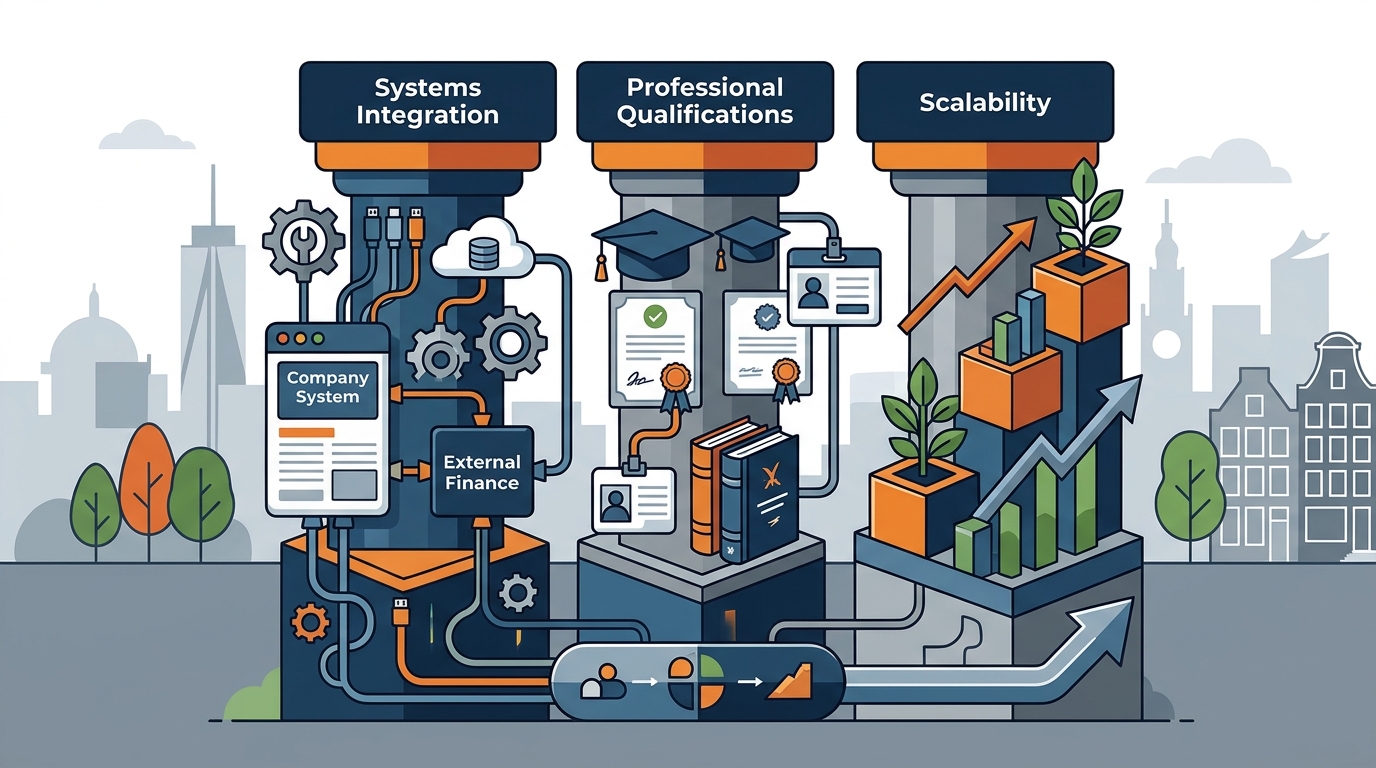
International companies need a Dutch finance and tax department that integrates seamlessly with their systems, holds the right professional qualifications, and scales with their growth. Schmitz Tax Services provides this capability by offering the quality large companies keep in-house, with a single point of contact. This guide covers the three critical pillars of selection: systems integration, professional qualifications, and scalability. according to Netherlands State gov
Systems Integration
Systems integration is the technical process of connecting your existing accounting software with your external tax provider. For international companies, this connection is not just a convenience; it is the backbone of accurate and timely reporting. If your finance team in the home country uses a specific ERP or accounting platform, your Dutch partner must be able to ingest that data without manual re-entry. Manual data entry introduces errors and delays, which are costly in a jurisdiction like the Netherlands where deadlines are strict. according to Audit of a
Seamless Data Flow
A robust external department should support direct links with your accounting software. This allows financial data to be recorded and processed into VAT returns and annual accounts automatically. At Schmitz Tax Services, documents can be supplied continuously or per quarter through a link with your accounting software, a folder of scans, or the paperwork as you receive it. This flexibility ensures that your records stay current throughout the year, making the figures usable when you need them rather than only afterwards. according to Audit of a
Interim Reporting and Visibility
Integration is not just about input; it is about output. You need visibility into your Dutch financial position in real-time. Interim reporting is a critical component of this. It allows you to monitor cash flow, VAT obligations, and payroll taxes as they accrue, rather than discovering discrepancies at the year-end close. Errors in VAT returns often only come to light at the year-end close, when putting them right takes more work than it would have at the time. A provider that offers interim reporting through an integrated system helps you catch these issues early.
Professional Qualifications
Professional qualifications refer to the specific expertise and background of the individuals handling your Dutch tax affairs. In the Netherlands, the tax landscape is complex, involving income tax, corporate income tax, VAT, and payroll tax. The person advising you must understand not just the rules, but the practical implications of those rules for your specific structure. This is where the distinction between a generic bookkeeper and a specialized tax adviser becomes critical.
Background in Multinationals
Look for a provider with experience in cross-border structures and multinational operations. Thomas Schmitz, the founder of Schmitz Tax Services, began his career in tax advisory for multinationals with a substantial Dutch presence. He handled structures, cross-border questions, and their consequences in both the short and the long term. Later, he moved in-house at a multinational, where he held responsibility for the Dutch tax position as a board member. This dual perspective, from the advisory side and the operational side, ensures that advice is not just theoretically sound but practically implementable.
Clarity and Communication
Qualifications are not just about technical knowledge; they are about the ability to explain that knowledge. Well-reasoned advice is worth little without implementation and follow-up. It only pays off once it lands in practice. A qualified adviser should be able to explain the tax consequences of a decision in clear language, so that you can explain the conclusions to your business partner, your spouse, or your bank. Schmitz Tax Services emphasizes this clarity, ensuring that you understand what you are getting into before anything is signed.
Scalability
Scalability is the ability of your external finance and tax department to grow with your business. As an international company, your needs will change. You might start with a simple sole proprietorship and later convert to a BV (private limited company). You might add employees, expand into new EU markets, or restructure your holding company. Your tax provider must be able to adapt to these changes without you having to switch providers or re-explain your business from scratch.
Adapting to Legal Form Changes
One of the most common scalability challenges is the conversion of an eenmanszaak (sole proprietorship) into a BV. This is a significant decision that affects your liability, tax burden, and future growth. The timing of this conversion is critical, and it requires careful planning. A scalable provider will advise you on when this becomes worthwhile and handle the transition smoothly. They will also guide you on whether or not to set up a holding structure, which is a common strategy for protecting assets and optimizing tax efficiency.
Handling Cross-Border Complexity
Scalability also means handling the complexity of operating in multiple countries. If you have a first client or employee across the border, the tax consequences can be significant. A provider that specializes in international tax can help you navigate these issues. They can advise on the M-form in the year of arrival or departure, and on foreign income or assets that belong in the Dutch return. This ensures that you remain compliant in all jurisdictions where you operate.
Comparison of Service Models
| Feature | Generic Bookkeeper | Specialized Tax Adviser (e.g., Schmitz Tax Services) |
|---|---|---|
| Systems Integration | Manual entry, limited software support | Direct link with accounting software, continuous data flow |
| Professional Background | General accounting experience | Experience in multinationals and in-house tax roles |
| Scalability | Fixed scope, limited advisory | Adapts to legal form changes and cross-border growth |
| Communication | Technical jargon, limited explanation | Clear language, written advice with recommendations |
| Point of Contact | Rotating staff, no single owner | Single point of contact, direct access to the adviser |
Key Takeaways
- Systems integration is essential for accurate and timely reporting; look for direct links with your accounting software.
- Professional qualifications should include experience in multinationals and in-house tax roles, not just general accounting.
- Scalability is critical; your provider must be able to adapt to changes in your legal form and cross-border operations.
- Clarity of communication is a key indicator of a qualified adviser; they should be able to explain complex tax issues in simple terms.
- A single point of contact ensures consistency and accountability, avoiding the confusion of rotating staff.
- Interim reporting helps you catch errors early, rather than discovering them at the year-end close.
- Fixed pricing for defined engagements provides budget certainty and avoids unexpected costs.
- Choosing a provider that specializes in your specific situation, such as expats or international companies, ensures relevant and practical advice.
Frequently Asked Questions
What is the difference between a bookkeeper and a tax adviser?
A bookkeeper records financial transactions and prepares basic reports. A tax adviser provides strategic advice on tax planning, compliance, and structuring. While a bookkeeper handles the day-to-day administration, a tax adviser helps you make decisions that minimize your tax burden and ensure long-term compliance.
Can I keep using my existing accounting software?
Yes. Schmitz Tax Services can integrate with your existing accounting software. This allows for a seamless flow of data, reducing the need for manual entry and minimizing the risk of errors. You can supply documents through a link with your software, a folder of scans, or the paperwork as you receive it.
How does Schmitz Tax Services handle cross-border tax issues?
With a background in tax advisory for multinationals, Schmitz Tax Services is well-equipped to handle cross-border tax issues. They can advise on the tax consequences of having clients or employees across the border, and on the proper filing of foreign income and assets in the Dutch return.
What is the M-form and when do I need to file it?
The M-form is a tax return that you must file in the year you arrive in or leave the Netherlands. It is used to determine your tax liability for the period you were resident in the country. If you are an expat or are relocating, you will likely need to file this form.
How does Schmitz Tax Services price its services?
Recurring work has a fixed fee per period, which is adjusted if the scope of work structurally changes. What a tax return or bookkeeping service costs for your situation is agreed before the work begins. This provides budget certainty and avoids unexpected costs.
Can I get a second opinion on advice from another adviser?
Yes. Schmitz Tax Services offers one-off work, including a second opinion on a piece of advice or a return. This is useful if you have doubts about the advice you have received from another provider, or if you want to ensure that your current structure is sustainable.
What happens if my records are not up to date?
If your records are a year behind, they can still be corrected. Schmitz Tax Services can bring a backlog in your records up to date. This is important because up-to-date records prevent corrections to the VAT returns, which often only come to light at the year-end close.
Is Schmitz Tax Services suitable for international companies?
Yes. Schmitz Tax Services specializes in providing tax returns, bookkeeping, and tax advice for business owners and expats, including international companies. They offer the quality large companies have in-house, with one point of contact you can simply message.
Conclusion
Choosing the right external Dutch finance and tax department is a critical decision for any international company. By focusing on systems integration, professional qualifications, and scalability, you can ensure that your Dutch operations are compliant, efficient, and ready to grow. Schmitz Tax Services offers a specialized approach that combines technical expertise with clear communication and a single point of contact. To plan your visit or discuss your specific needs, for an introductory conversation. There is no charge for the conversation itself, and no preparation is needed.