
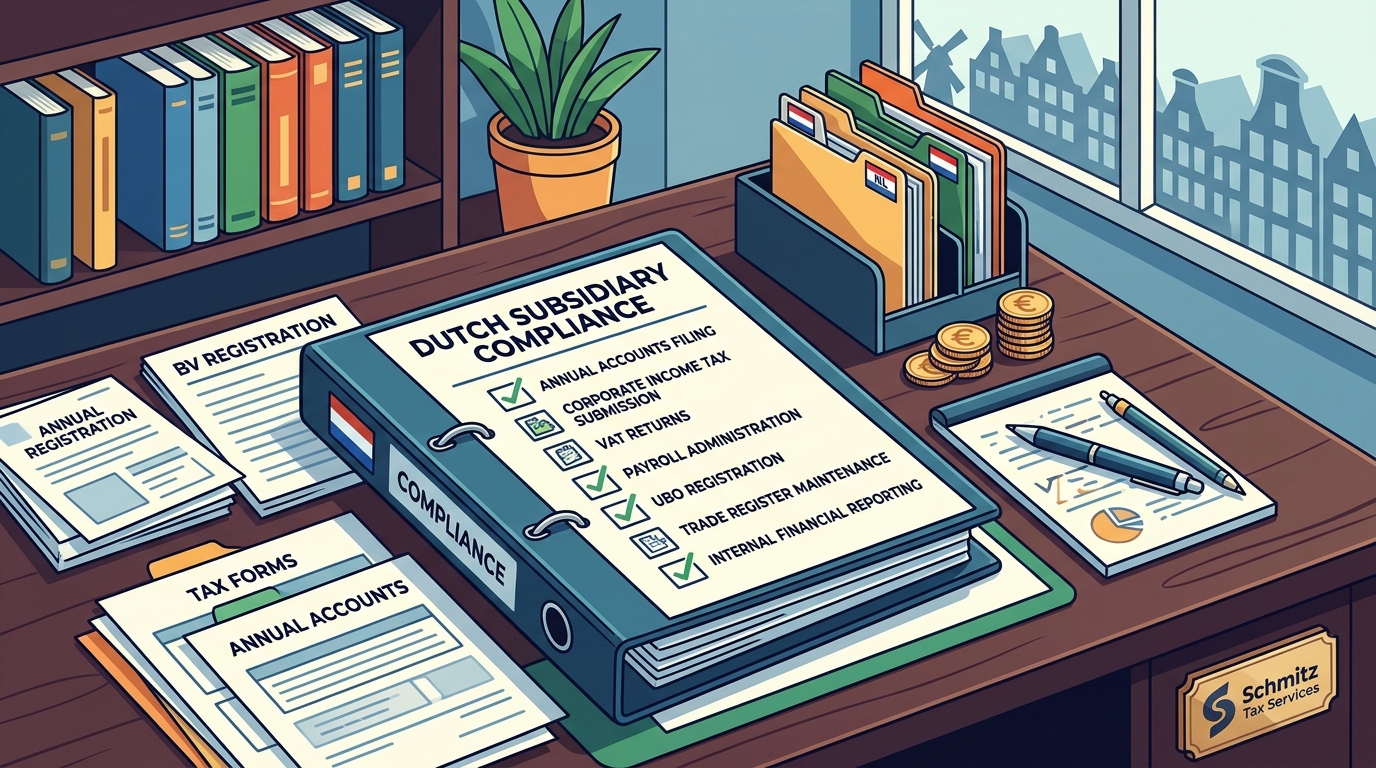
International companies operating through a Dutch private limited company (BV) face a specific set of administrative and fiscal obligations. These requirements ensure that the entity operates transparently within the Dutch legal framework. Schmitz Tax Services helps international business owners navigate these rules with a single point of contact for tax and accounting matters.
1. Corporate Income Tax (Vennootschapsbelasting) Filing
File your corporate tax return within five months of the financial year-end. Every Dutch BV must file an annual corporate income tax return with the Dutch Tax Administration (Belastingdienst). The deadline is typically five months after the end of the financial year. This return includes the annual accounts and a detailed explanation of the taxable profit.
2. Annual Accounts and Chamber of Commerce Filing
Deposit your annual accounts with the Chamber of Commerce within twelve months. Dutch law requires BVs to prepare annual accounts in accordance with Dutch accounting standards. These accounts must be filed with the Dutch Chamber of Commerce (Kamer van Koophandel) within twelve months of the financial year-end. This public filing ensures transparency for stakeholders and creditors.
3. VAT (BTW) Returns and EC Sales Lists
Submit quarterly VAT returns and EC Sales Lists for intra-community trade. If your Dutch subsidiary makes taxable supplies, it must register for VAT and file quarterly returns. For companies trading within the European Union, an EC Sales List (Lijst van Verwerkers) is also required. These filings report the value of goods and services supplied to other EU member states.
4. Payroll Tax (Loonheffing) Obligations
Withhold and remit payroll taxes for all employees working in the Netherlands. Employers must register for payroll tax and withhold income tax and social security contributions from employee wages. These amounts must be remitted to the Tax Administration on a monthly or quarterly basis. Failure to do so can result in significant penalties and interest.
5. Transfer Pricing Documentation
Document intercompany transactions to meet arm's length principles. International companies must ensure that transactions between the Dutch subsidiary and its foreign affiliates are priced at arm's length. This requires maintaining transfer pricing documentation that demonstrates compliance with OECD guidelines. The Dutch Tax Administration may request this documentation during an audit.
6. Corporate Governance and Director Responsibilities
Ensure directors fulfill their statutory duties and maintain proper records. Directors of a Dutch BV have a legal duty to act in the best interest of the company. This includes maintaining accurate financial records and ensuring timely filing of tax returns. Directors can be held personally liable for unpaid taxes if they fail to meet these obligations.
7. M-Form and International Reporting
Report foreign assets and income using the M-form when applicable. If the Dutch subsidiary has foreign assets, income, or is part of a multinational group, it may need to file an M-form. This form reports international tax positions and helps prevent double taxation. It is a critical component of international tax compliance for Dutch entities.
Choosing the Right Compliance Approach
Select a compliance strategy that aligns with your business model and operational scale. For smaller entities, a streamlined approach focusing on core filings may suffice. For larger groups, a robust transfer pricing and governance framework is essential. Schmitz Tax Services provides tailored advice to match your specific situation.
Frequently Asked Questions
What is the deadline for filing corporate income tax in the Netherlands?
The corporate income tax return must be filed within five months of the end of the financial year. For a calendar year, this is typically May 1 of the following year.
Do I need to file annual accounts if my BV has no activity?
Yes, even dormant BVs must file annual accounts with the Chamber of Commerce. This ensures the entity remains in good standing with Dutch authorities.
What is the difference between VAT and payroll tax?
VAT is a consumption tax on goods and services, while payroll tax is a withholding tax on employee wages. Both are separate obligations with different filing frequencies.
Can I use my home country's accounting standards for the Dutch BV?
No, Dutch BVs must prepare annual accounts in accordance with Dutch accounting standards. However, group accounts may be prepared under IFRS if required by the parent company.
How does Schmitz Tax Services help with these requirements?
Schmitz Tax Services provides full bookkeeping, tax returns, and annual accounts for Dutch BVs. We act as a single point of contact for all compliance matters, ensuring deadlines are met and filings are accurate.
Next Steps
Ensure your Dutch subsidiary meets all compliance requirements by partnering with a dedicated tax adviser. Contact Schmitz Tax Services to discuss your specific needs and receive a tailored proposal.