
Setting up a private limited company (BV) in the Netherlands involves more than just signing a deed of incorporation. It requires a structured approach to legal, tax, and administrative obligations to ensure long-term sustainability. Schmitz Tax Services guides business owners through these critical phases, ensuring that the operational reality of the business aligns with its tax position from day one.
1. Define the Business Model and Legal Form
Start with the operational reality, not the tax structure. A BV is a legal entity that separates personal assets from business liabilities, offering limited liability to its shareholders. Before choosing a structure, you must clearly define your activities, how money flows, and the risks involved. Tax consequences follow from the business model and actual activities, not the other way round. Without a clear understanding of the operational side, the tax position cannot be properly assessed.
2. Draft and Execute the Deed of Incorporation
Formalize the entity through a notary. The deed of incorporation is the foundational legal document that establishes the BV. It must be executed before a Dutch notary and includes the company name, registered office, share capital, and the names of the initial directors. This step legally brings the company into existence and defines the rights and obligations of the shareholders and management.
3. Register with the Chamber of Commerce
Obtain your official business registration. After the deed is signed, the notary registers the company with the Dutch Chamber of Commerce (Kamer van Koophandel). This registration provides the company with a unique Chamber of Commerce number, which is required for opening bank accounts, signing contracts, and filing tax returns. It is the public record of the company's existence in the Netherlands.
4. Apply for Tax Identification Numbers
Secure the necessary IDs for tax compliance. The company must register with the Dutch Tax Administration (Belastingdienst) to obtain a VAT number, a corporate income tax number, and a payroll tax number if employees are hired. These numbers are essential for invoicing, filing returns, and complying with Dutch tax law. Proper registration ensures that the company is recognized by the tax authorities from the start of its operations.
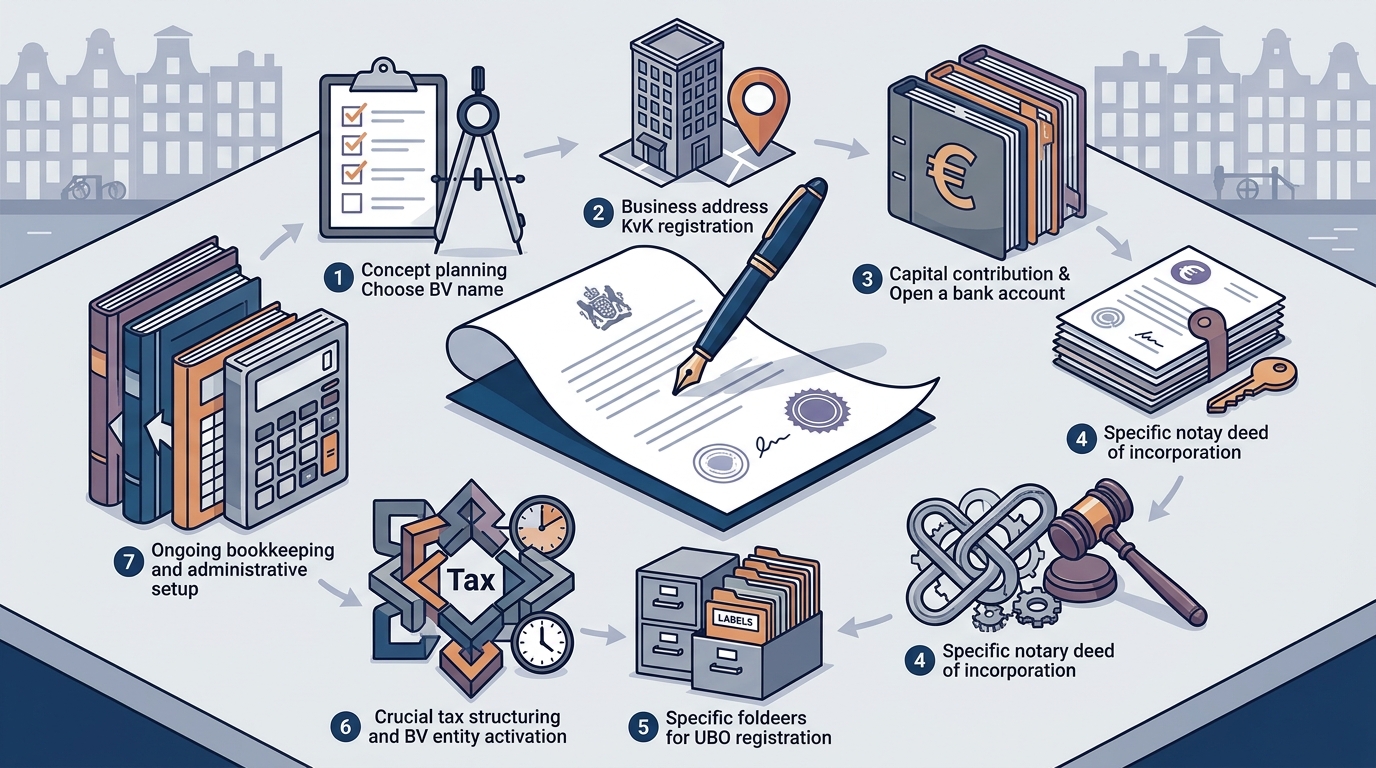
5. Open a Corporate Bank Account
Separate business finances from personal funds. A dedicated bank account is mandatory for maintaining the legal separation between the BV and its owners. Banks will require the deed of incorporation, Chamber of Commerce registration, and identification of the directors and beneficial owners. This account serves as the primary channel for all business transactions, ensuring clear financial records.
6. Establish Bookkeeping and Accounting Systems
Implement a robust record-keeping process. Bookkeeping is the systematic recording of all financial transactions, forming the basis for annual accounts and tax returns. For a BV, full bookkeeping and annual accounts are required, which must be filed with the Chamber of Commerce. Keeping records up-to-date throughout the year prevents errors and ensures that figures are usable when needed, rather than only at year-end.
7. Set Up Payroll and Compliance Frameworks
Manage employee obligations and ongoing compliance. If the BV employs staff, it must register for payroll tax and comply with wage tax regulations. This includes withholding tax on salaries and reporting to the Tax Administration. Additionally, the company must establish internal controls and compliance frameworks to monitor deadlines for VAT returns, corporate income tax filings, and annual accounts. Proactive management of these obligations reduces the risk of penalties and ensures smooth operations.
Choosing the Right Approach
When organizing a Dutch BV, prioritize clarity and sustainability over complexity. Structures that are overly complex or designed solely for tax optimization without operational substance carry higher risks and may prove unsustainable over time. Focus on a setup that reflects the true nature of your business activities and ensures that all administrative and tax obligations are managed efficiently.
Frequently Asked Questions
How long does it take to register a Dutch BV?
The registration process typically takes a few weeks. The notary handles the registration with the Chamber of Commerce and the Tax Administration after the deed of incorporation is signed. The exact timeline can vary depending on the notary and the complexity of the structure.
Do I need a local address for my BV?
Yes, a BV must have a registered office in the Netherlands. This can be a physical office, a virtual office, or the address of a service provider. The registered office is where official documents can be served and is listed in the Chamber of Commerce register.
What is the minimum share capital for a Dutch BV?
Can a foreigner own a Dutch BV?
Yes, foreigners can own a Dutch BV. There are no restrictions on foreign ownership of Dutch companies. However, the company must comply with Dutch tax and legal requirements, and the beneficial owners must be identified for anti-money laundering purposes.
What are the annual filing obligations for a BV?
A BV must file its annual accounts with the Chamber of Commerce within 12 months of the end of the financial year. It must also file a corporate income tax return and quarterly VAT returns. If the BV employs staff, it must also file payroll tax returns.
How does Schmitz Tax Services help with BV setup?
Schmitz Tax Services provides guidance on the tax implications of setting up a BV, including the choice of legal form, dividend and salary strategies, and compliance requirements. The firm offers bookkeeping and tax return services to ensure that the company's records are up-to-date and that all filings are made on time.
Next Steps
Ready to structure your Dutch BV with confidence? Contact Schmitz Tax Services for a free introductory conversation to discuss your specific situation and determine the best path forward.